Long before tourists discovered its crystalline coves and golden Old Town, Rhodes was consecrated to something far more ancient. The Greeks — a civilisation who saw divinity in every wave, every wind, every shimmering harbour — looked upon this island and saw the hand of Poseidon. God of the seas, earthquakes, and storms, Poseidon held dominion over the Mediterranean, and Rhodes, rising dramatically from its sapphire waters, was one of his most beloved domains.
To stay in Rhodes today is to inhabit a place of profound mythological resonance. At Olympus Hospitality, we find ourselves humbled by that legacy every single morning — watching the Aegean catch fire at sunrise from our garden terrace in Marathonas, just five minutes' walk from the sea.
Poseidon: Lord of the Aegean
In Greek mythology, Poseidon was the second son of Titans Cronus and Rhea — brother to Zeus and Hades. When the three brothers divided the cosmos after overthrowing Cronus, Zeus claimed the sky, Hades the underworld, and Poseidon was granted dominion over the seas. It was a kingdom of staggering breadth. For a seafaring civilisation like the Greeks, whose trade routes, military ambitions, and daily survival depended entirely upon calm waters, Poseidon was not merely a deity to admire — he was a god to appease, to honour, and to fear.
He was worshipped throughout the Greek world, from Corinth to Thessaloniki, from the Cyclades to the shores of Asia Minor. But the Eastern Mediterranean — the warm, mercurial Aegean — was his heartland. And within the Aegean, few places were more sacred than Rhodes.
Rhodes: The Island Claimed by Helios and Beloved by the Sea
Ancient mythology offers a striking origin story for Rhodes. When the gods divided the earth among themselves, the sun god Helios was absent — out illuminating the cosmos — and so he received no portion. Zeus, moved by this injustice, offered to draw lots again, but Helios refused. He had seen an island, barely risen from the ocean floor, glittering beneath his rays. He claimed it as his own: this was Rhodes, the island of the sun.
But Helios and Poseidon were not rivals here. In ancient Rhodes, both were venerated. The sea shaped everything — the island's economy, its legendary navy, the famous harbour of Mandraki where ships from across the ancient world arrived laden with silk, spice, and marble. The Rhodians understood that their prosperity was utterly dependent on the goodwill of the sea god. Temples were built, offerings cast into the waters, and the great festivals of the Rhodian calendar honoured the ocean's power.
Poseidon's influence can still be felt today. Stand at Mandraki Harbour — just ten minutes from Olympus Hospitality — and watch the fishing boats bob gently where triremes once anchored. The water is the same. The light is unchanged. Something ancient persists here.
The Mythology of the Sea in Rhodian Life
Rhodes was no ordinary island in the ancient Greek imagination. It was the home of the Heliades — daughters of Helios — and the birthplace of powerful naval traditions stretching back to the Bronze Age. The Rhodian fleet was among the finest in the ancient Mediterranean, and Rhodian sailors were famed for their seamanship, trading as far west as Spain and as far east as Persia.
In this context, Poseidon was not abstract theology. He was professional necessity. Before every voyage, Rhodian sailors offered prayers and libations at his shrines. Storms were his wrath. Calm seas were his blessing. Dolphins — sacred to Poseidon — were considered auspicious omens when spotted from a Rhodian deck.
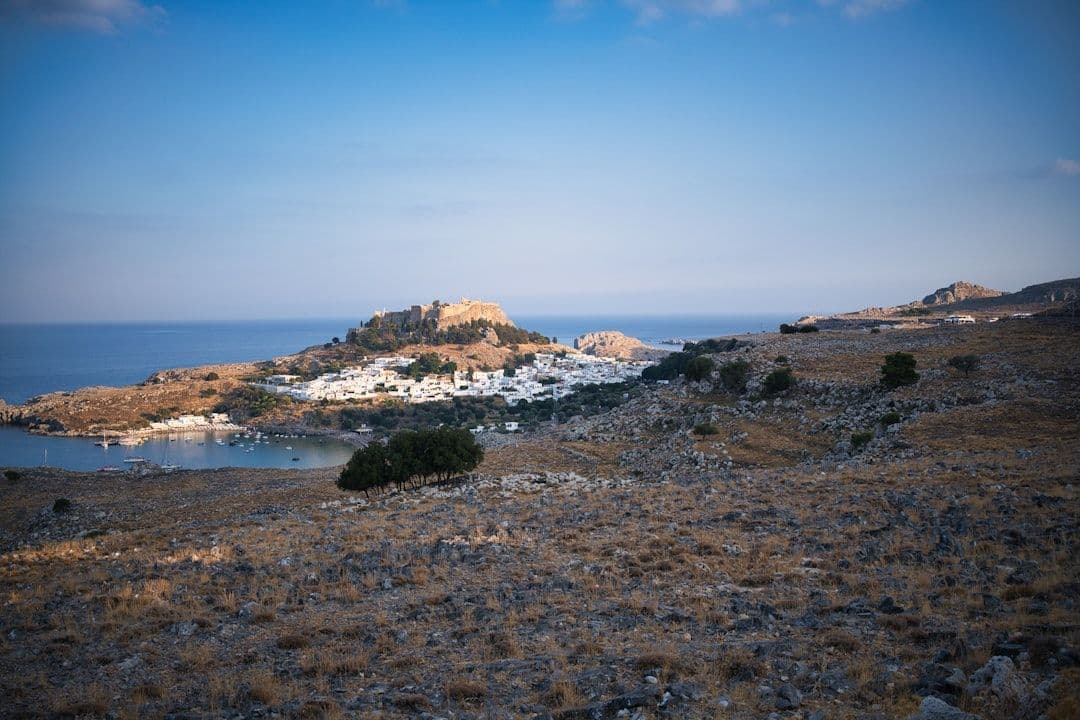
The sea god also appears in the myth of the founding of Lindos, the island's ancient city perched dramatically on a promontory above a shimmering bay. The Lindians claimed divine favour, and the sea routes leading to Lindos were considered protected waters. Even today, sailing into Lindos Bay from the south, you understand immediately why the ancients believed the gods lived here.
The Colossus: A Statue Born of Poseidon's Waters
No discussion of ancient Rhodes and the sea is complete without the Colossus — one of the Seven Wonders of the Ancient World. Built around 280 BCE to celebrate Rhodes' victory over the besieging forces of Antigonus I Monophthalmus, the Colossus stood at the harbour entrance, a colossal bronze statue perhaps 33 metres tall, gazing out over the sea that had protected the island.
Whether it depicted Helios or a god of the sea remains debated. But what is beyond dispute is this: the statue was inextricably linked to Rhodes' maritime identity. It stood where land met sea, where human ambition met divine power. Poseidon may not have been cast in bronze, but his domain — that shimmering, infinite expanse of Aegean blue — framed every angle of the Colossus.
The statue fell in an earthquake around 226 BCE, its ruins lying for centuries before being sold. But the harbour it watched over remains, and the sense of mythological grandeur has never entirely left Rhodes' waterfront.
Why Rhodes Still Feels Sacred Today
There is something about the light on this island that feels different. Ancient writers remarked on it. Modern visitors feel it too — a quality of luminosity, a clarity in the air and sea that seems almost otherworldly. The Greeks attributed it to divine attention; to Helios' particular love for this island, to Poseidon's restless presence in its waters.
In Marathonas, the small coastal village that is home to Olympus Hospitality, the sacred and the everyday exist in easy companionship. The beach — a five-minute walk from our door — is fringed by tamarisk trees and washed by waters of implausible clarity. Fishing boats set out at dawn. Swallows skim the surface. At the right time of evening, the sea turns the colour of hammered bronze, and you find yourself thinking that the ancients may have had a point.
Stay Where Myth Meets the Mediterranean
At Olympus Hospitality, we have named our suites after the gods who shaped this landscape: Zeus, Poseidon, and Ares. Our Poseidon Suite, in particular, honours the sea that surrounds Rhodes — designed with the deep blues and sculptural forms that evoke the god's eternal domain.
Whether you are drawn by mythology, history, or simply the desire to wake up five minutes from one of the Aegean's most beautiful coastlines, Rhodes offers something that few places can match: the feeling that you are standing on ground the gods once walked.
Come and discover it for yourself. Visit www.olympushospitality.eu to explore our suites and book your stay. The sea is waiting.